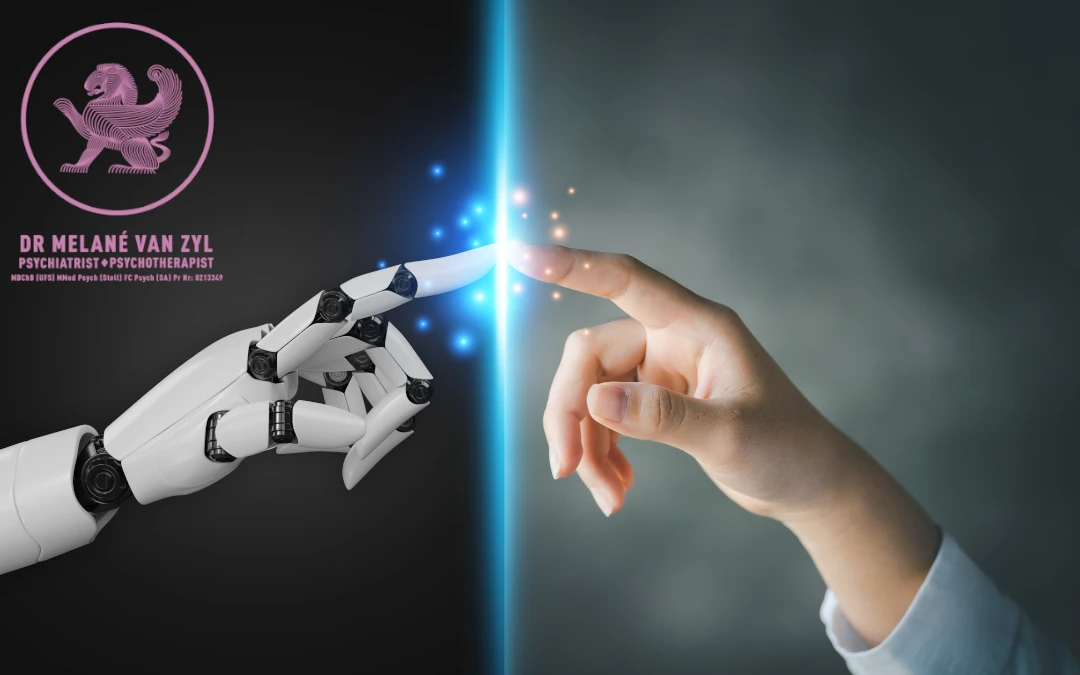
There’s a question many of us are quietly starting to ask a machine instead of a person. It might be about anxiety, a relationship that’s fraying, a fear we haven’t said aloud, or simply whether what we’re feeling is normal. The answer comes back instantly, warmly, without judgement — and it feels, for a moment, like being cared for.
According to Dr Melané van Zyl, a board member of the South African Society of Psychiatrists, that feeling is exactly what we need to think carefully about. Speaking on Voice of the Cape’s Mid-Morning Medley, she described a shift happening across society: more and more of us, from adults to young children, are turning to AI for comfort and counsel. The technology has genuine uses. The danger lies in mistaking a convincing simulation of care for the real thing.
It feels like it cares
The heart of the matter, Dr van Zyl says, is a simple illusion. An AI is warm, attentive and endlessly available, and it’s designed to be pleasing — it tends to tell us what we want to hear and reinforce what we already think. So it feels like it cares. The emotions we feel in the exchange are real, while the relationship on the other side of it is not. “It doesn’t really care about you,” she says. “It looks like it cares.”
“It sounds very caring, but it doesn’t really care about you — and AI can be confidently wrong,” Dr van Zyl explained.
Confidently wrong
Part of what makes this so risky is the tone of certainty. An AI can deliver a mistaken answer with complete conviction. It doesn’t know you — not your history, your culture or your context — and yet it will respond as though it does. “AI can be confidently wrong,” Dr van Zyl warns, and for someone in a vulnerable moment, a confident wrong answer can be far more harmful than an honest “I don’t know.”
There’s a privacy cost, too, that few of us stop to consider. These conversations are not as confidential as they feel. Whatever we type in can be stored and may become identifiable later on — a sobering thought when the things we bring to AI are often our most personal. And if adults struggle to see through the illusion, children have almost no chance.
The duty we all share
The illusion doesn’t touch everyone equally. As adults, we can at least bring some scepticism to the exchange; children can’t. Their identity, judgement and relationship skills are still forming, and they lack the discernment to recognise that a caring-sounding machine doesn’t actually care. They bring far more than homework to these tools — questions about sexuality, relationships and bullying — and often do so in secret, treating the AI as an authority even higher than a parent. Age restrictions do little to stop it: children well below the intended age are already using these tools, and, as Dr van Zyl puts it, “they do it, and they believe it.”
This is why these cautions need to become an ongoing conversation, with the adults around children saying out loud what many of us only think: that the AI doesn’t truly know or care about them, that it can be confidently wrong, and that what they type isn’t private. And this isn’t a job for parents alone. Most of us, whether or not there are children in our own homes, are an aunt, an uncle, a grandparent, a teacher or a neighbour to a child who is growing up with these tools — which makes looking out for them a responsibility we all share.
The most important message is about where to draw the line: some problems must always go to a trusted person rather than an app — suicidal thoughts, abuse or bullying, frightening or unusual thoughts, or feeling unsafe.
Because so much of this happens out of sight, Dr van Zyl encourages the adults in a child’s life to watch behaviour rather than wait for a confession. Signs worth noticing include:
- increased secrecy or withdrawal from family
- poor sleep, or constant time on the phone
- slipping schoolwork
- visible signs of emotional distress
Each is simply an invitation to gently open a door — to ask, without alarm, how a child is really doing.
AI isn’t the enemy
None of this makes AI the enemy. Dr van Zyl is clear that, used well, it has real value — she and her colleagues use it to lighten their workload and free up time for patients, and she welcomes patients who arrive with questions it has sparked. The problem is when the simulation is asked to do what a person must: to diagnose, to decide, to keep someone safe, to truly understand. A machine can offer information and a moment’s comfort, but it cannot read the flat affect of someone slipping into crisis, sit with another person through something painful, or be genuinely accountable to them. Those remain human tasks — and they are the ones that matter most.
Perhaps the most useful thing any of us can do, Dr van Zyl suggests, is to stay honest about our own motives. Treat AI as a thinking aid, and ask:
Is this helping me speak more clearly to the people in my life — or helping me avoid them?
Am I looking for reassurance from a machine instead of a person?
The comfort AI offers is real enough to be tempting, and just hollow enough to leave us lonelier if we let it stand in for connection. As individuals and as a society, the task is to enjoy the tool for what it is without mistaking it for what it isn’t — and, sooner rather than later, to turn to a real person who can actually care.
Where to find help
If you or someone you know is struggling, the South African Depression and Anxiety Group (SADAG) offers a comprehensive website and helplines: www.sadag.org
LISTEN TO THE FULL INTERVIEW BELOW:
When AI Feels Like a Friend
– This article is based on an interview with Dr Melané van Zyl, board member of the South African Society of Psychiatrists, on Voice of the Cape’s Mid-Morning Medley.